This guide is for Darwin 4WD owners planning trips to Kakadu, Litchfield and beyond in the dry season. It covers the electrical side of a touring setup: dual batteries, charging on the move, running a fridge, and building wiring that survives corrugated tracks, dust and creek crossings.
Sponsored
Your auto electrical business, front and centre in Darwin
This spot is shown to people looking for auto electrical help anywhere in Darwin. See sponsor spots and prices.
How can we help?
Need it fixed?
Get a quote from a local 4WD Dual Battery Setups for Kakadu, Litchfield and the Top End auto electrician, for anything from a flat battery to a full fit-out.
Get a quoteBuying parts?
Quality auto electrical parts from Ozautoelectrics, an established Australian supplier since 2010, dispatched through a nationwide network. For retail and trade buyers.
Shop partsDoing it yourself?
Free step-by-step guides written for Northern Territory conditions, with the parts you’ll need listed for each job.
Browse DIY guidesAuto electrician in 4WD Dual Battery Setups for Kakadu, Litchfield and the Top End?
Are you an auto electrical business? List your business on this site.
List your business on this siteTop End trips and what they ask of your 4WD
Kakadu and Litchfield are two of the most popular trips out of Darwin. Litchfield National Park is about 120 km south of Darwin, reached on sealed roads through Batchelor or via the Cox Peninsula Road. Kakadu is further, with the Arnhem Highway running 227 km from the Stuart Highway near Humpty Doo to Jabiru, and the park itself covering almost 20,000 square kilometres.
The main roads are sealed, but many of the best spots aren't. In Litchfield, the Reynolds River Track and the Lost City track are 4WD only, and the Reynolds Track has creek crossings. In Kakadu, Parks Australia lists sites such as West Alligator Head and Maguk as 4WD only. Jim Jim Falls and Twin Falls are also 4WD sites, but Parks Australia has announced the area will stay closed through 2026 while cyclone-damaged roads are upgraded, with reopening planned for the 2027 dry season.
Tracks open and close with the seasons, and some stay closed well into the dry season. Check the Kakadu access report, the NT Parks status page for Litchfield and the NT Road Report before you leave.
Why a second battery makes sense
A fridge running in hot Top End weather can draw a lot of power over a day, especially if it's opened often or packed warm. Add lights, phone and camera charging and maybe a pump, and a single starting battery will soon be flat. A second battery runs your camp gear while the starting battery is kept for starting the engine.
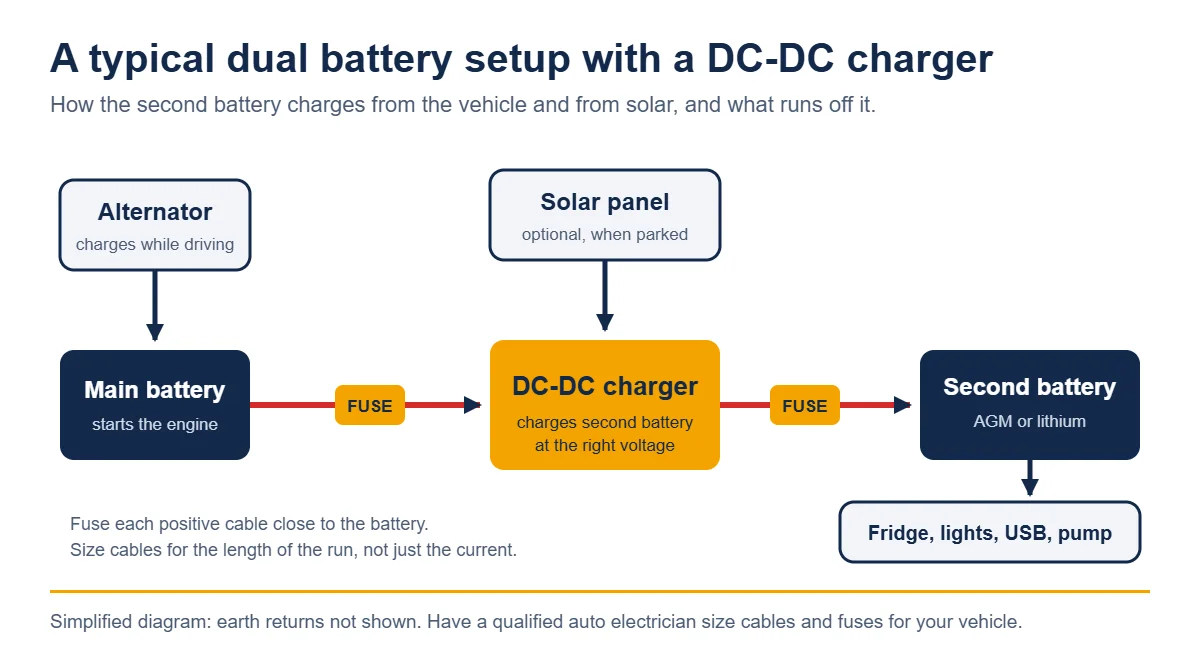
The basic idea is simple. The second battery is charged while you drive, and it's kept separate from the starting battery when the engine is off. Our guide on how a dual battery system works explains the layout in more detail.
Advertisement
DC-DC charger or isolator
Older setups often used a voltage-sensitive relay or isolator that simply joins the two batteries when the engine is running. That still works on some older vehicles. Many newer 4WDs, though, have smart alternators that lower their output voltage once the starting battery is charged, which can leave an auxiliary battery undercharged.
A DC-DC charger boosts and regulates the charge to the second battery and suits different battery types, including lithium. Many also accept solar input, which is useful when you're parked at a campground for a few days. Read DC-DC charger or isolator to work out which suits your vehicle, and check your battery maker's charging requirements before you buy.
Building it to survive corrugations
Corrugated dirt roads are where poorly built setups fail. Hours of constant vibration loosen terminals, crack plugs, wear through insulation and break batteries out of weak trays. Most of the faults that show up halfway down a Top End track come from mounting and wiring, not from the charger.
Build for vibration from the start:
- Use a solid battery tray or box designed for your battery, with a hold-down that clamps it firmly.
- Support cables every short distance with proper clips or ties, so they can't flex at the terminals.
- Run cables through grommets wherever they pass through metal, and use split conduit where they could rub.
- Use quality crimped lugs, not pinched or soldered-only joints that can crack under vibration.
- Fuse both ends of any cable connected to a battery, as close to the battery as practical.
- Keep cables clear of exhaust parts and moving steering or suspension components.
- Recheck every terminal and mount after your first rough trip, then before each big one.
Cable size and connections
Cable that's too thin is the most common reason a dual battery system underperforms. Running the feed from the engine bay to a battery in the tub or a canopy is a long run, and voltage drop over that length means less charge in the battery. Size the cable for the current and the full length of the circuit, including the earth return. Our guide on what size cable you need for 12V has the method.
Anderson plugs are a tidy way to connect a fridge, a camper trailer or a portable solar panel. Make sure the pins are crimped properly, and fit dust caps. Red Top End dust gets into everything, and a dusty or loose Anderson contact can heat up under load. See how to wire an Anderson plug.
Dust, water and creek crossings
Fine dust gets into switches, sockets and fuse holders, and creek crossings can soak wiring that sits low on the chassis. Mount chargers, fuse blocks and isolators high and in a protected spot. Choose sealed or weatherproof fittings for anything outside the cabin.
At the time of checking, the NT Government listed water crossings on the Reynolds Track at around 500 to 600 mm deep, and depths change through the season. Know your vehicle's wading limits, and never drive into floodwater. Remember that crocodiles live in Top End waterways, so walking a crossing to check its depth isn't safe. After a crossing, check that lights, sockets and the charger still work.
Checks before you head out
A short run on a local dirt road before the big trip will show up loose mounts and rattles while you're still close to home.
- Charge the auxiliary battery fully at home, and check it holds charge overnight with the fridge running.
- Confirm the charger shows it's charging with the engine running.
- Check every terminal, lug and mount is tight.
- Carry spare fuses of the right ratings, a few crimp lugs and a multimeter.
- Pack a jump starter or jumper leads that can reach between vehicles.
Getting the work done
Dual battery installs are popular before the dry season opens, so book early. If you're on the rural side of town, start with our pages for Humpty Doo on the road to Kakadu, or Palmerston on the way south to Litchfield.
Parts for this job
Order quality parts online from Ozautoelectrics, dispatched Australia-wide.
Get it done: get a quoteDo it yourself: shop DC-DC chargers
Get it done: get a quoteDo it yourself: shop Anderson plugs
Get it done: get a quoteDo it yourself: shop battery cables
Get it done: get a quoteDo it yourself: shop battery boxes
Questions Darwin drivers ask
Do I need a 4WD to visit Kakadu and Litchfield?
Not for everything. The main roads into both parks are sealed, and many sites can be reached in a 2WD. Some sites are 4WD only, including the Reynolds River and Lost City tracks in Litchfield and sites such as Maguk and West Alligator Head in Kakadu. Check the park access reports and the NT Road Report before you go.
Why does my dual battery setup stop charging on corrugated roads?
Vibration loosens terminals and lugs, cracks plugs and can wear through cable insulation. Check every connection, fuse holder and Anderson plug, and look for chafed cables where they pass through metal. A loose earth is a common culprit. Good mounting, well-supported cables and quality crimped lugs prevent most of these faults.
Do I need a DC-DC charger for a newer 4WD?
Many newer 4WDs have smart alternators that lower their voltage once the starting battery is full, which can leave a second battery undercharged through a simple isolator. A DC-DC charger fixes this by boosting and regulating the charge. Check your vehicle's alternator type and your battery maker's charging requirements before choosing.
Need an auto electrician in Darwin?
Find local auto electricians and mobile services in the Darwin directory, or start with your area: Litchfield, Palmerston, Darwin City.
Search auto electrical parts
Searches the full range at Ozautoelectrics, opening in a new tab. Popular: dual battery · LED light bars · trailer plugs · fuses
Run an auto electrical business in 4WD Dual Battery Setups for Kakadu, Litchfield and the Top End?
- New to Ozautoelectrics? Apply for trade pricing on quality auto electrical parts.
- Already a trade customer? Log in and order parts at your trade price.
- Want more local customers? List your business on this site so drivers in 4WD Dual Battery Setups for Kakadu, Litchfield and the Top End can find you.
Not confident doing this yourself?
There’s no shame in handing it over. A local auto electrician can diagnose the fault properly and get it done safely, especially for anything involving brakes, airbags, hybrid systems or air-con gas.
Get a quote from a local auto electrician Or shop the parts and do it yourself